
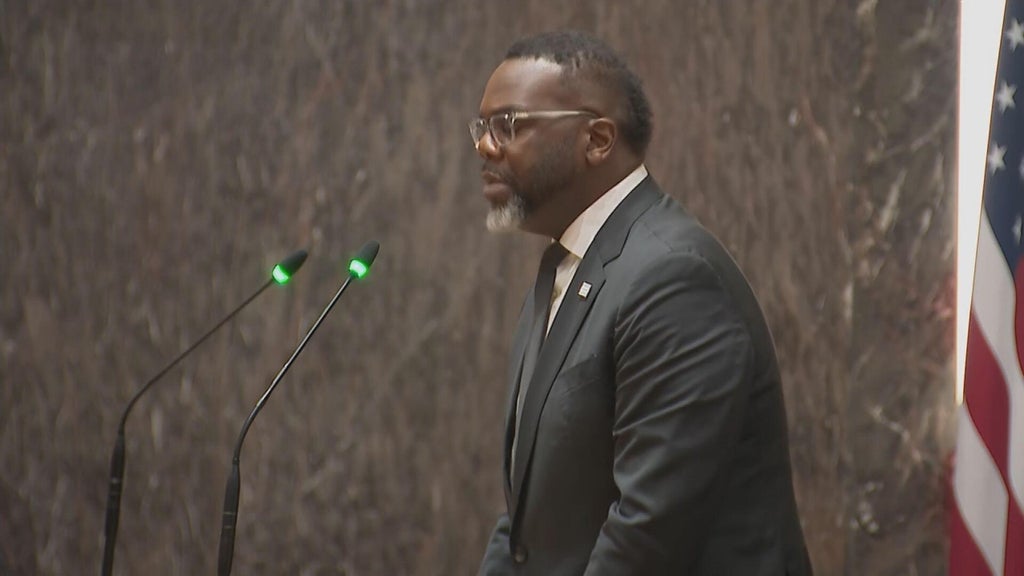
Chicago Mayor Brandon Johnson unveiled his $17.6 billion 2027 budget proposal for the city on Wednesday, relying on a head tax that most aldermen have already rejected.
"My 2027 budget ensures that every Chicagoan receives their fair share of the investments, services, and opportunities that define our city, funded by responsible spending cuts that protect essential services and by asking wealthy corporations to pay their fair share," Johnson said in his budget address at City Hall.
The mayor wants to take another crack at his controversial corporate head tax to help offset an $882 million shortfall, despite most aldermen warning him ahead of time that such a proposal is dead on arrival. He is looking to charge companies with 125 or more full-time employees $25 per worker per month.
Companies whose employees work in parts of Chicago designated as Socioeconomically Disadvantaged Areas would qualify for credits to cover the cost of the tax for each employee in those areas.
While this tax is often called a head tax, Mayor Johnson prefers to think of it as the "equitable employer tax."
Mayor Johnson's office estimates the head tax would raise $101 million a year. He said it would affect less than 3% of Chicago's businesses. The revenue would go toward pothole repairs, libraries, and gun violence reduction.
As he prepares to run for re-election in 2027, the mayor is clearly reaching out to his progressive base, arguing corporations need to chip in more to help the city balance its budget.
Johnson said Chicagoans tell him they want corporate America to help with the heavy lift of erasing the city's $882 million budget deficit.
"There is no reason to coddle or feel sorry for corporations. They are doing just fine," Johnson said. "Large corporations can and should contribute more to the city whose people, infrastructure, and neighborhoods make their success possible."
But the same City Council coalition that passed the 2026 budget without a head tax over Johnson's objections said his second bid for the tax is "dead on arrival."
Last month, the 29 alders who are part of the City Council Budget Accountability Coalition sent a joint letter to the mayor declaring their willingness to work together on a budget plan. However, the group specifically requested no head tax, and said they would not support any move that increases costs for companies that keep or create jobs in Chicago.
"It was disingenuous for the mayor to put the head tax into the budget. Twenty-nine of us signed that letter. Clearly that part of it's dead on arrival," Ald. Bill Conway (34th) said after Johnson's budget address.
The mayor's opponents argue the head tax is a job killer that would discourage companies from relocating to Chicago.
"The majority of council will not support, so the fact that it was proposed in here feels very much like a political tactic," Ald. Nicole Lee (11th) said.
Johnson proposed a $21-per-employee monthly head tax on companies with more than 100 employees as part of his 2026 budget proposal last year, and later revised it to a $33-per-employee monthly head tax on companies with more than 500 employees. The City Council voted it down, and the mayor's opponents passed an alternate budget plan over his objections.
There is no indication that the parliamentary arithmetic in the City Council has shifted in favor of a head tax this year. Some Chicago aldermen warned weeks ago that a head tax proposal would be dead on arrival.
The alders wrote to the mayor that while the current budget gap forecast is lower than previously estimated, "it remains a fiscal challenge of the first order," one which they believe three principles should anchor. One of those principles is rejecting a head tax or any other "tax on job growth."
The other two principles the alders are endorsing are rejecting an increase in property taxes and avoiding relying on "Springfield revenues that have not been approved."
Meanwhile, Johnson also proposed a 15-cent packaging waste tax that would expand the city's existing retail bag tax to include all forms of packaging for carry-out or delivery, bringing in an estimated $9 million.
He also wants sports betting companies to pay a 20% tax, up from 10.25% to bring in $37 million, although the city's sports betting tax is facing a court challenge, with opponents arguing only the state of Illinois is authorized to impose such a tax.
The mayor also plans to increase personal property lease taxes from 15% to 20%. The tax rate for car leases would remain at 15%, while leases for film production equipment would see their tax reduced to 11%. The mayor's office estimates the changes to the personal property lease tax would generate $234 million.
Johnson also estimates the city will bring in an additional $18 million in parking ticket revenue from the plan to expand the Smart Streets program citywide. The program uses automated cameras to ticket drivers who block bus lanes, bike lanes, and crosswalks.
On top of the required $2.97 billion payment to cover the costs of city employee pensions, Johnson is proposing a $364 million supplemental pension payment.
The mayor also plans to declare a $520 million surplus in tax increment finance revenue. Of that, the city will net roughly $100 million, and $285 million will go to the Chicago Public Schools. The rest will go to various other government bodies in Chicago.
Johnson's team also suggests taking out a loan of $480 million to help pay off police misconduct claims sooner, which the team says would cut down on legal costs.
The mayor's acting budget director, Jonathan Ernst, said his office has been through every department line by line — shaving what it can without impacting city services.
The City Council Budget Committee will hold a series of meetings over the next three weeks to allow alders to question each city department about the mayor's budget plan. The City Council has until the end of the year to pass a 2027 spending plan.
This year is an election year, leaving some alders on the fence on the mayor's budget proposal, and prepared for a long fight over the 2027 spending plan.
"The politics of it are challenging, right? The way it was presented last year kind of left folks pretty entrenched, and so trying to figure out how to get to 26 [votes] is going to be, I think, harder this time," said Ald. Andre Vasquez (40th), who voted against the 2026 budget passed by the mayor's City Council opponents.


